
Having a Facebook page and a website is multi-channel. Connecting them so your customer doesn’t feel like they’re talking to two different companies is omni-channel. And figuring out which one actually made you money? That’s attribution.
If you want to position your brand as a leader, you need to understand how these three play together. In this article I’ll show you how.
1. The Definitions
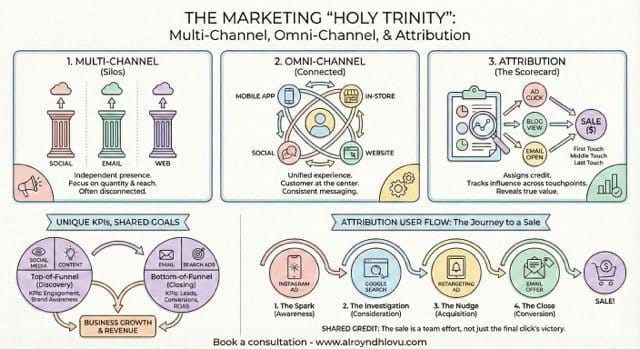
Multi-Channel: “We Are Everywhere” Multi-channel marketing is about quantity. You are on LinkedIn, Google Search, TikTok, and Email. The goal is reach. However, these channels often operate in silos. Your social media manager might not know what your email specialist is sending today. It’s like a band where everyone is playing a different song.
Omni-Channel: “We Are Connected” Omni-channel is about quality and consistency. It puts the customer, not the channel, at the centre. If a user abandons a cart on mobile, they get an email reminder on desktop, and maybe a retargeting ad on Instagram featuring the exact product they left behind. It is a seamless, unified experience.
Attribution: “Who Gets the Credit?” Attribution is the scorecard. It is the science of assigning credit to the touchpoints that influenced a conversion. Without it, you are flying blind, likely dumping your budget into the channel that “claimed” the sale (usually the last one) while starving the channels that actually started the conversation.
2. The Trap of Uniform KPIs
Here is where most strategies fall apart: Seeing and treating all channels the same.
In a healthy ecosystem, not every channel shares the same Key Performance Indicators (KPIs).
- Social Media (Top of Funnel): Its job is often Discovery and Engagement. If you judge TikTok solely on “Last-Click ROAS” (Return on Ad Spend), you might cut it—and watch your search volume plummet two weeks later.
- Email & Search (Bottom of Funnel): These are your closers. They capture the demand created elsewhere.
The Strategy: Use multi-channel tactics to cast a wide net, use omni-channel thinking to nurture the lead, and use attribution to understand the assist.
3. The Attribution User Flow: A Real-World Example
Let’s look at how a sale actually happens. The “Linear” path (Click Ad -> Buy Product) is a myth. The modern user journey is messy, circular, and multi-device.
The Scenario: The Journey of a Sale
Touchpoint 1 (Awareness):
Sarah is scrolling Instagram on her commute. She sees a witty video ad for your new SaaS tool. She watches 50% of it, laughs, but keeps scrolling.
- Channel Role: Awareness.
- Attribution Reality: If you use “Last Click” attribution, Instagram gets zero credit here.
Touchpoint 2 (The Investigation):
Two days later, Sarah remembers the brand name. She goes to Google and types it in (Brand Search). She visits your blog, reads a “How-To” article, and leaves.
- Channel Role: Consideration/Education.
Touchpoint 3 (The Nudge):
You have a pixel on your site (smart move). You serve Sarah a retargeting banner ad on a news site she reads. It offers a “14-Day Free Trial.” She clicks, signs up for the trial, but doesn’t buy yet.
- Channel Role: Acquisition.
Touchpoint 4 (The Close):
The trial is ending. Your automated email sequence kicks in with a “Last Chance to Upgrade” offer. Sarah clicks the link in the email and pays for the subscription.
- Channel Role: Conversion.
The Verdict? If you look at Last-Touch Attribution, Email marketing looks like a hero (100% credit). You might think, “Let’s put all our budget into Email!”
But if you look at Multi-Touch or Time-Decay Attribution, you realize that without that Instagram ad (First Touch) and the Google search (Middle Touch), the Email would never have had anyone to talk to.
FAQ:
Q: Should I start with Multi-channel or Omni-channel?
A: Start with multi-channel to establish presence, but build with an omni-channel vision. Don’t try to integrate everything day one if you don’t have the data infrastructure.
Q: Which attribution model is best?
A: There is no “best,” only “best for you.”
- First-Touch: Good for seeing what builds awareness.
- Last-Touch: Good for seeing what closes deals.
- Linear/U-Shaped: Best for understanding the full team effort.
The Takeaway
Marketing isn’t about finding the one “silver bullet” channel. It’s about building an ecosystem where channels pass the ball to each other.
If you are tired of guessing which half of your marketing budget is working, it might be time to bring in an expert- ME! I don’t just run ads; I build systems that track, attribute, and convert.
Ready to stop guessing? Let’s talk.

I’m a full-stack digital marketing, business technology and branding strategy consultant. I help businesses grow by designing high-impact business solutions through data-driven marketing, analytics, automation, AI & creative strategy. With over a decade of experience in digital marketing, branding, media and content development, as well as business optimization and automation technologies, I’ve worked with a wide range of brands and organizations—like Meta, Total Sports, Jenna Clifford, the IFC, Energy Capital & Power, African Agri Council, and more—to boost their visibility, strengthen their brand presence, and drive profitability through data-driven, audience-focused solutions. I’m passionate about my work and bring a unique blend of creativity and dedication to every project I take on.