
Remember 2015? It was a simpler time. You could post a grainy photo of your office coffee machine on Facebook, and somehow, 4,000 people would see it. You felt like a media mogul.
Fast forward to 2026, and the party is officially over.
If you’ve been staring at your analytics dashboard wondering why your follower count is rising but your engagement is flatlining, I have some news: It’s not you. It’s the landlord. The social media platforms have changed the locks, and the rent is due.
Let’s talk about this quiet decline, why the pay-to-play model is the new reality, and cruciall, how you can still win, whether you have a massive ad budget or absolutely zero dollars to spend.
The “Quiet Decline” by the Numbers
I believe in data over feelings and the data is sobering.
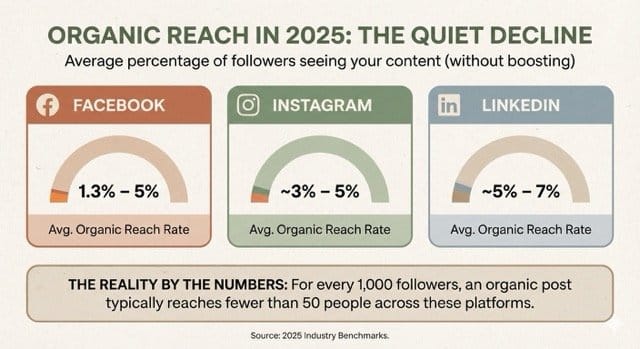
We are seeing a historic dip in organic reach across the “Big Three” platforms. If you have 1,000 followers, here is the harsh reality of how many people actually see your non-boosted posts:
- Facebook: ~1.3% to 5% (Yes, you read that right. 13 people.)
- Instagram: ~3% to 5%
- LinkedIn: ~5% to 7% (The current outlier, but dropping fast for Company Pages)
The days of “free” distribution are gone. As of 2025, with over 5.4 billion users flooding these networks, algorithms have shifted from showing you what you follow to showing you what you’re likely to buy or watch for 3 hours.
Why Is This Happening?
Think of Facebook and Instagram as landlords. For a decade, they let businesses live in their apartment complex for free to make the neighborhood lively. Now that the neighborhood is popular, they want rent.
That “rent” is the Pay-to-Play model.
Platforms like Meta and TikTok are businesses. They are prioritizing ad revenue and “discovery engine” content (like Reels from strangers) over your brand’s status updates. If you aren’t paying, you aren’t prioritized—unless you are creating viral-grade entertainment, which, let’s be honest, is hard to do when you’re selling B2B SaaS or plumbing services.
How to Win Strategy 1: The “Zero Budget” Pivot
If you don’t have an ad budget, don’t panic. You just need to stop shouting and start whispering. Here is how to pivot whilst staying within your means:
1. The Personal Brand Company pages are dead zones. People trust people, not logos. On LinkedIn especially, personal profiles see significantly higher reach than company pages.
- The Play: Have your founder or key team members post insights from their personal profiles, then tag the business. Use the human algorithm to your advantage.
2. SEO is the New Social Social posts are indexed by Google. Your TikToks and LinkedIn articles are now showing up in search results.
- The Play: Stop writing cute captions. Write searchable ones. Use keywords in your bio and posts. If you are a graphic designer in in a specific area, say that explicitly.
3. Community > Audience An audience listens; a community talks back. Since the feed is broken, move to the DMs (Direct Messages).
- The Play: Spend 15 minutes a day commenting on other people’s posts. Send a personalized voice note to new followers. “Engagement” is the only metric that still forces the algorithm to pay attention to you.
Pro Tip: “Renting visibility (ads) is fine, but owning your audience is better. Always try to move your social followers to an email list where you control the reach.”
How to Win Strategy 2: The “Smart Spender” Approach
If you are already running ads, or have a small budget ($500+), don’t just “Boost” posts blindly. That’s like throwing coins into a fountain and wishing for ROI.
1. The “Organic Audit” Method Never put money behind a post that didn’t perform well organically first.
- The Play: Post organically. Wait 24 hours. If a post gets above-average engagement, that is your creative winner. Put ad spend behind that specific post to pour gasoline on a fire that’s already burning.
2. Retargeting the “Window Shoppers” Use organic video content (Reels/Shorts) to cast a wide net. These videos are cheap to make and get decent reach.
- The Play: Create a “Custom Audience” in Meta Ads Manager of people who watched 50% of your Reel. Serve them a sales ad. They already know who you are; they just need a nudge.
3. Leverage AI for Creative You don’t need a $10k agency retainer for creative design anymore.
- The Play: Use tools to test different headlines and image variations rapidly. Let the AI decide what your audience wants to see. (We do a lot of this at Dejamedia—it’s a game changer for lowering Cost Per Click).
The Bottom Line
The decline of organic reach isn’t the end of social media marketing; it’s just the maturation of the industry. The “free lunch” is over, but the kitchen is still open.
You have two choices going forward:
- Pay for attention (Ads).
- Earn attention (High-value content, personal branding, and community building).
The best brands do both.
Q & A
Qestion: Is organic reach really dead?
Answer: Not “dead,” but it’s on life support. You can’t rely on it for consistent growth anymore without a strategy shift toward video (Reels/Shorts) or personal branding.
Question: Should I boost every post?
Answer: Absolutely not. Only boost high-performing organic posts. If it didn’t work for free, paying for it won’t fix the message—it will just help you lose money faster.
Question: What is the best platform for B2B in 2025?
Answer: LinkedIn is still king for B2B, but focus on personal profiles of your team members rather than just the Company Page.
Ready to audit your strategy?
If you feel like you’re posting into the void, let me help you fix that. I love to help businesses build “algorithm-proof” marketing ecosystems that blend smart tech, paid media, and genuine brand storytelling.
Contact me to book a consultation.

I’m a full-stack digital marketing, business technology and branding strategy consultant. I help businesses grow by designing high-impact business solutions through data-driven marketing, analytics, automation, AI & creative strategy. With over a decade of experience in digital marketing, branding, media and content development, as well as business optimization and automation technologies, I’ve worked with a wide range of brands and organizations—like Meta, Total Sports, Jenna Clifford, the IFC, Energy Capital & Power, African Agri Council, and more—to boost their visibility, strengthen their brand presence, and drive profitability through data-driven, audience-focused solutions. I’m passionate about my work and bring a unique blend of creativity and dedication to every project I take on.